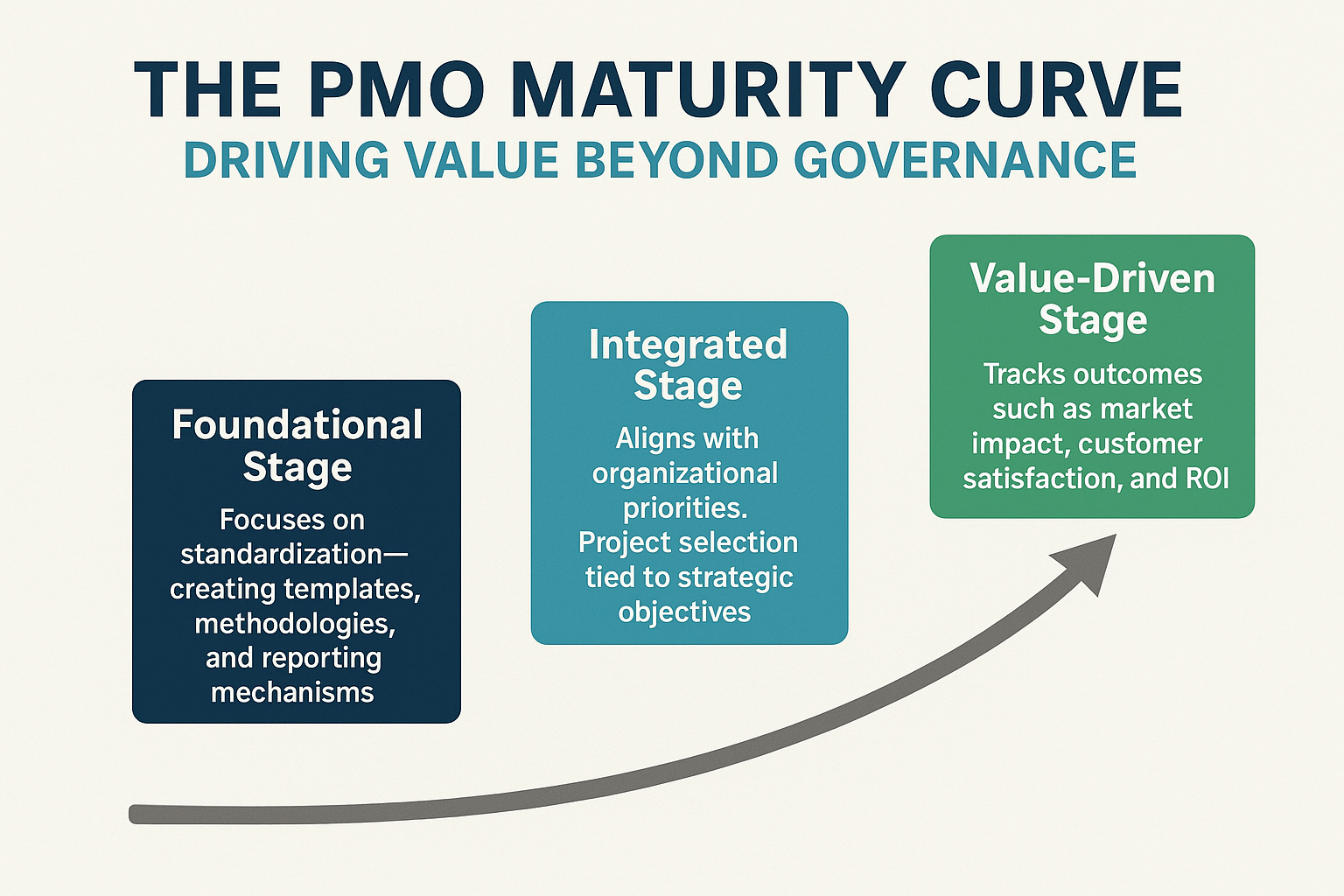

A structured PMO maturity model provides executives and PMO leaders with a practical way to assess capability, benchmark performance, and prioritize investment. Rather than focusing only on compliance or reporting, a maturity-based approach clarifies how the PMO contributes to measurable enterprise value.
According to the Project Management Institute (PMI), organizations with high project management maturity waste 28 times less money than those with low maturity. In Pulse of the Profession 2023, PMI reports that poor project performance costs organizations 9.9% of every dollar invested. Mature governance and standardized practices materially reduce that loss.
For C-level executives, the implication is direct: PMO maturity is not administrative overhead—it is financial performance management.
What a PMO Maturity Model Really Measures
A robust maturity model does more than evaluate documentation standards. It assesses capability across four integrated domains:
- Governance and Decision Rights – Clarity of portfolio oversight, stage gates, and escalation pathways.
- Strategic Alignment – Evidence that projects link to enterprise objectives and measurable outcomes.
- Delivery Capability – Predictability of cost, schedule, and benefits realization.
- Data and Reporting Integrity – Consistency, transparency, and executive-level insight.
The Association for Project Management (APM) emphasizes in its PMO Competency Framework that mature PMOs shift from administrative support toward influencing strategy and driving benefits realization. This shift is a defining characteristic between Level 2 “process-enabled” PMOs and Level 4–5 “value-led” PMOs.
The Five Levels of PMO Maturity
While models vary, most follow a five-level structure:
Level 1 – Ad Hoc
Projects operate independently. Governance is inconsistent. Reporting is reactive.
Level 2 – Defined
Standard templates and processes exist. Compliance improves, but value tracking remains limited.
Level 3 – Integrated
Portfolio governance is formalized. Resource management and risk oversight are coordinated.
Level 4 – Managed
Data informs decision-making. Benefits tracking and capacity planning are embedded.
Level 5 – Optimized
Continuous improvement is institutionalized. Scenario planning and predictive analytics guide investment decisions.
Research from Gartner indicates that organizations with advanced portfolio management practices are significantly more likely to achieve strategic objectives, particularly when investment decisions are guided by outcome-based metrics rather than activity metrics.
Why Many PMOs Stall at Mid-Maturity
In practice, most PMOs plateau at Level 2 or 3. Common causes include:
- Overemphasis on templates instead of outcomes
- Limited executive sponsorship
- Fragmented portfolio data systems
- Lack of measurable value metrics
The McKinsey & Company has repeatedly observed that transformation initiatives fail not because of strategy, but because of weak governance and execution discipline. A PMO that lacks maturity becomes a reporting function instead of a value driver.
Turning Assessment into Action
A maturity assessment should result in a prioritized roadmap—not a static score.
Effective PMO leaders translate findings into three actions:
- Align governance to enterprise risk appetite. Clarify approval thresholds and escalation protocols.
- Introduce outcome-based KPIs. Shift reporting from milestone tracking to benefits realization and value delivered.
- Modernize portfolio visibility. Integrate financial, risk, and capacity data into a single executive dashboard.
This is where the PMO maturity model becomes strategic. It allows leaders to justify investment in systems, talent, and governance improvements using measurable capability gaps rather than opinion.
What Executives Should Ask
For boards and C-suite leaders evaluating their PMO, the right questions include:
- Do we have real-time visibility into portfolio risk exposure?
- Can we quantify benefits realization six to twelve months post-delivery?
- Are resource allocation decisions driven by strategy or urgency?
If the answers are unclear, maturity is likely constrained.
Conclusion
A PMO is not mature because it produces reports on time. It is mature when it measurably improves capital allocation, reduces delivery risk, and enables strategic agility. A structured maturity model provides the framework to move from administrative control to enterprise value creation.
For executives and PMO practitioners alike, the objective is not simply higher maturity—it is better strategic outcomes.
Reference
Pulse of the Profession 2023 | Project Management Institute | 2023
PMO Competency Framework | Association for Project Management | 2018
Delivering on Strategy: The Power of Portfolio Management | Gartner | 2021
The Inconvenient Truth About Change Management | McKinsey & Company | 2015