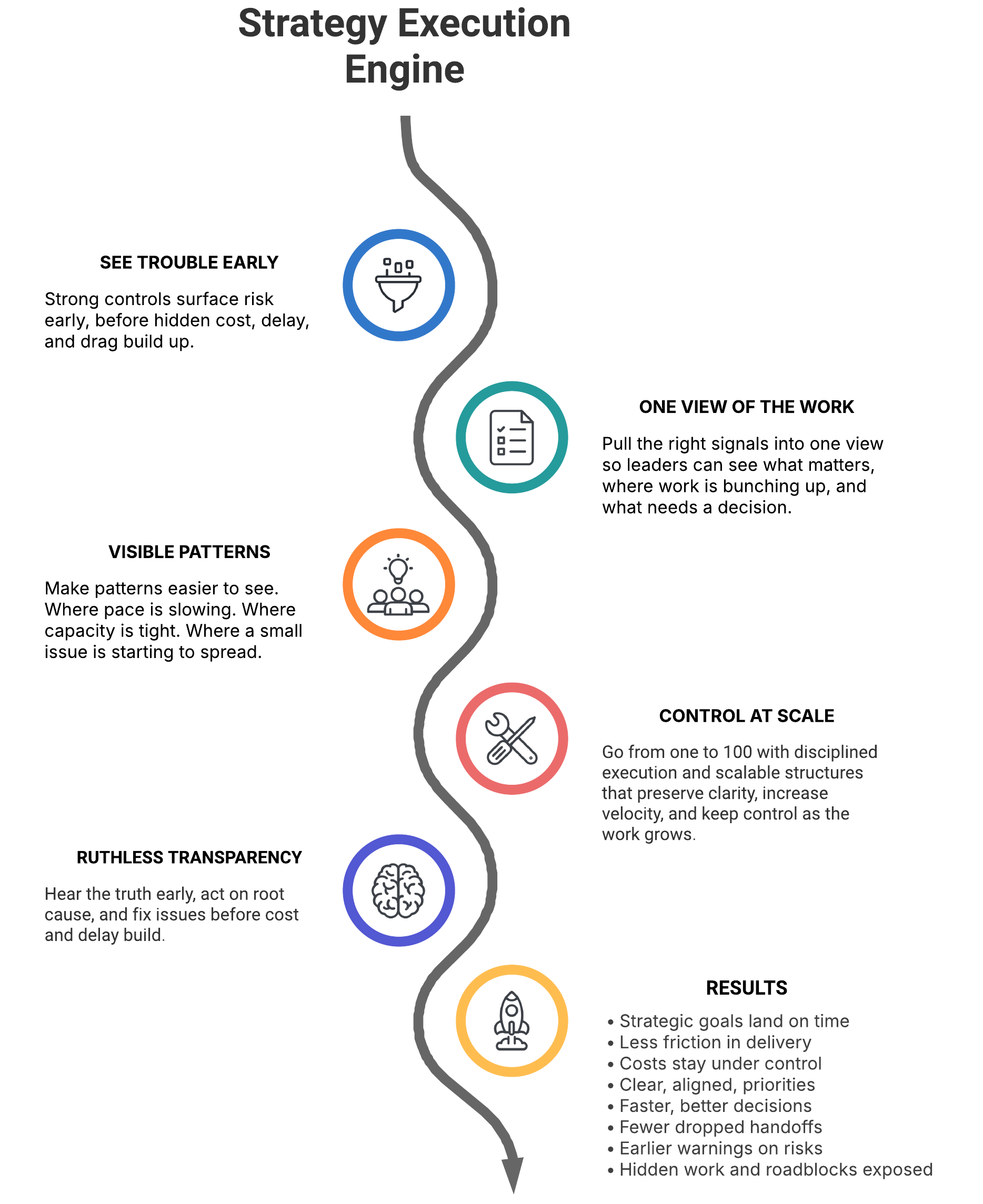

Strategy does not create results until an organization converts priorities into funded, staffed, governed work. That makes portfolio governance more than a PMO reporting process: it is the leadership mechanism that determines which strategic commitments receive resources, which projects wait, and where intervention is required.
The execution gap is measurable. PMI’s 2025 research, based on more than 5,800 project professionals and stakeholders, found that only half of projects meet its modern definition of success, while 35% of executives identified a disconnect between planning and execution as the top barrier to reinvention.
For senior leaders, the implication is uncomfortable but useful: a healthy project portfolio is not the same thing as a successful strategy.
The PMO Should Help Leaders Make Trade-Offs
A common portfolio mistake is treating governance as a monthly status meeting. Leaders review red, yellow, and green projects, listen to explanations, and move on.
That produces visibility without necessarily producing decisions.
The ROPE Framework takes a different view. Its Portfolio Management Value Chain connects demand management, project intake, resourcing and prioritization, initiation, execution, and results. The framework also makes a clear ownership distinction: the PMO supports, questions, consults, and facilitates, while senior leadership remains accountable for portfolio decisions and results.
That distinction matters. A PPMO cannot compensate for executives who refuse to make choices.
Three Questions Every Portfolio Governance Meeting Should Answer
1. Are we doing the right work?
Every significant project should have a visible connection to an organizational objective, strategic priority, regulatory requirement, customer outcome, or material business problem.
2. Can we actually deliver it?
Strategy competes for the same people, money, technology, and leadership attention as operations. ROPE treats capacity optimization as an ongoing cycle of demand management, capacity planning, and capacity management—not a one-time staffing exercise.
3. What needs a leadership decision now?
Governance should expose conflicts, risks, resource collisions, and changes early enough for leaders to act. ROPE recommends twice-monthly demand management and portfolio governance meetings, with cadence adjusted for portfolio health, size, and throughput.
This is where portfolio governance becomes an execution control rather than an administrative ritual.
The Credit Union Test: What Happens When Priorities Collide?
Consider a credit union balancing a core-system modernization, cybersecurity remediation, regulatory commitments, member-experience improvements, and operational efficiency initiatives.
Every project may be individually justified. The portfolio can still be impossible to execute.
The executive question is therefore not, “Are all these projects important?” It is, “Given our finite capacity, which outcomes matter most, and what are we willing to delay?”
Harvard Business Review has reported that executives say they lose 40% of their strategy’s potential value through execution breakdowns. Michael Mankins argues that the problem often starts earlier, with flawed plans and choices rather than execution alone.
A strong PPMO makes those trade-offs visible before the organization commits beyond its capacity.
What Leaders Should Expect From the PPMO
The PPMO should provide a reliable view of:
- strategic alignment and expected business value;
- resource and capacity conflicts;
- portfolio-level risks and dependencies;
- projects requiring executive intervention;
- changes affecting strategic priorities;
- decisions that are overdue; and
- evidence that completed work produced its intended result.
McKinsey’s research reinforces the leadership point: fewer than one-third of organizations surveyed said their transformations were successful at both improving performance and sustaining those improvements.
The answer is not another dashboard. It is a management system that connects information to decisions, decisions to action, and action to measurable results.
Conclusion
Strategic execution is ultimately a leadership responsibility. The PPMO can create the transparency, controls, cadence, and analysis needed to make good portfolio decisions, but executives must own the choices—especially the difficult choice to stop, defer, or reshape work.
The strongest PPMOs do not simply tell leaders what is happening across the portfolio. They help leaders decide what happens next.
reference
Results Oriented Project Execution (ROPE) Framework: A Practical Approach to Successfully Completing Complex Projects and Programs | Paul Thompson | 2025
Fully Managed PMO Service Plan Runbook: Portfolio and Project Management Office Following the ROPE Framework | Paul Thompson | 2026
New PMI Research Reveals Strategy-Execution Gap Is Undermining Transformation And How to Close It | Project Management Institute | 2025 PMI research
Why do most transformations fail? A conversation with Harry Robinson | Harry Robinson, McKinsey & Company | July 10, 2019 McKinsey article
5 Ways the Best Companies Close the Strategy-Execution Gap | Michael Mankins | November 20, 2017 Harvard Business Review article
The Science Behind Successful Organizational Transformations | McKinsey & Company | 2021 McKinsey research