
When difficult work is done well, people start to believe the work is easy. That is a hidden risk in strategy execution.
Years ago, adidas watched us move their data center and systems across the country with a level of control that made the work look almost routine. The next time a similar need came around, they tried to manage it themselves.
Before long, the effort was in trouble, and we were called in late to bring it back under control.
That experience has stayed with me because it reveals something many executives experience but rarely name.
When complex initiatives are well led, the effort behind them becomes hard to see.
Meetings happen. Dashboards get updated. Risks get handled. Decisions move. Workstreams advance.
Everything looks under control.
And that is when someone asks the question that starts a lot of trouble:
“Why can’t we just do this ourselves?”
The Visible Work Is Not the Real Work
From the outside, complex project delivery can look simple.
There is a plan.
There is a dashboard.
There is a meeting cadence.
There are status updates, risks, owners, dates, and decisions.
Those things matter, but they are not the real work. They are the visible part of the work.
The real work lives below the surface.
It is the judgment to know which risks matter and which ones are noise. It is the structure that keeps teams aligned when priorities shift. It is the trust that allows difficult conversations to happen before issues become political. It is the time discipline, composure under pressure, pattern recognition, and small corrections that happen long before the problem becomes obvious.
It is knowing when to push.
When to slow down.
When to escalate.
When to listen.
When to hold the line.
That is the part most leaders do not see when the work is going well.
Like an iceberg, what people can see is only a fraction of what keeps the work moving.
Why Strategic Initiatives Start to Drift
Most strategic initiatives do not fall apart all at once.
They drift.
A decision takes a week longer than expected.
A dependency is assumed instead of confirmed.
A risk is discussed but not owned.
A stakeholder nods in the meeting but does not act afterward.
A vendor says they are on track, but no one tests the claim deeply enough.
A project manager updates the dashboard, but the real issue is still sitting in the hallway conversation no one wants to have.
None of these moments feel catastrophic by themselves.
That is why they are dangerous.
They accumulate quietly until the initiative becomes harder, slower, and more expensive than leadership expected. By the time the problem is visible at the executive level, the organization is often forced into crisis mode.
This is where many companies confuse project administration with strategy execution.
Project administration tracks the work.
Strategy execution keeps the work moving when pressure, ambiguity, politics, and constraints start pulling it apart.
The Mistake Leaders Make When Work Looks Easy
When a company sees a complex initiative delivered with control, it is natural to believe the method can be copied.
Copy the dashboard.
Copy the meeting.
Copy the template.
Copy the status report.
Assign someone internally to run the cadence.
But copying the visible pieces does not recreate the delivery discipline behind them.
A dashboard does not create transparency by itself.
A meeting does not create accountability by itself.
A status report does not create control by itself.
A PMO does not create value simply because it exists.
The value comes from how the system is used when the work gets hard.
That is where experience matters. That is where structure matters. That is where pattern recognition matters. That is where a strong delivery model separates itself from a collection of project management tools.
Making Hard Work Look Controlled
The best strategy execution does not always look dramatic.
It often looks steady.
Risks surface early.
Tradeoffs are named clearly.
Decisions move without unnecessary drama.
Teams know what matters now, next, and later.
Executives get the truth before they get a surprise.
The work still has pressure. The difference is that the pressure is being managed inside a system strong enough to hold it.
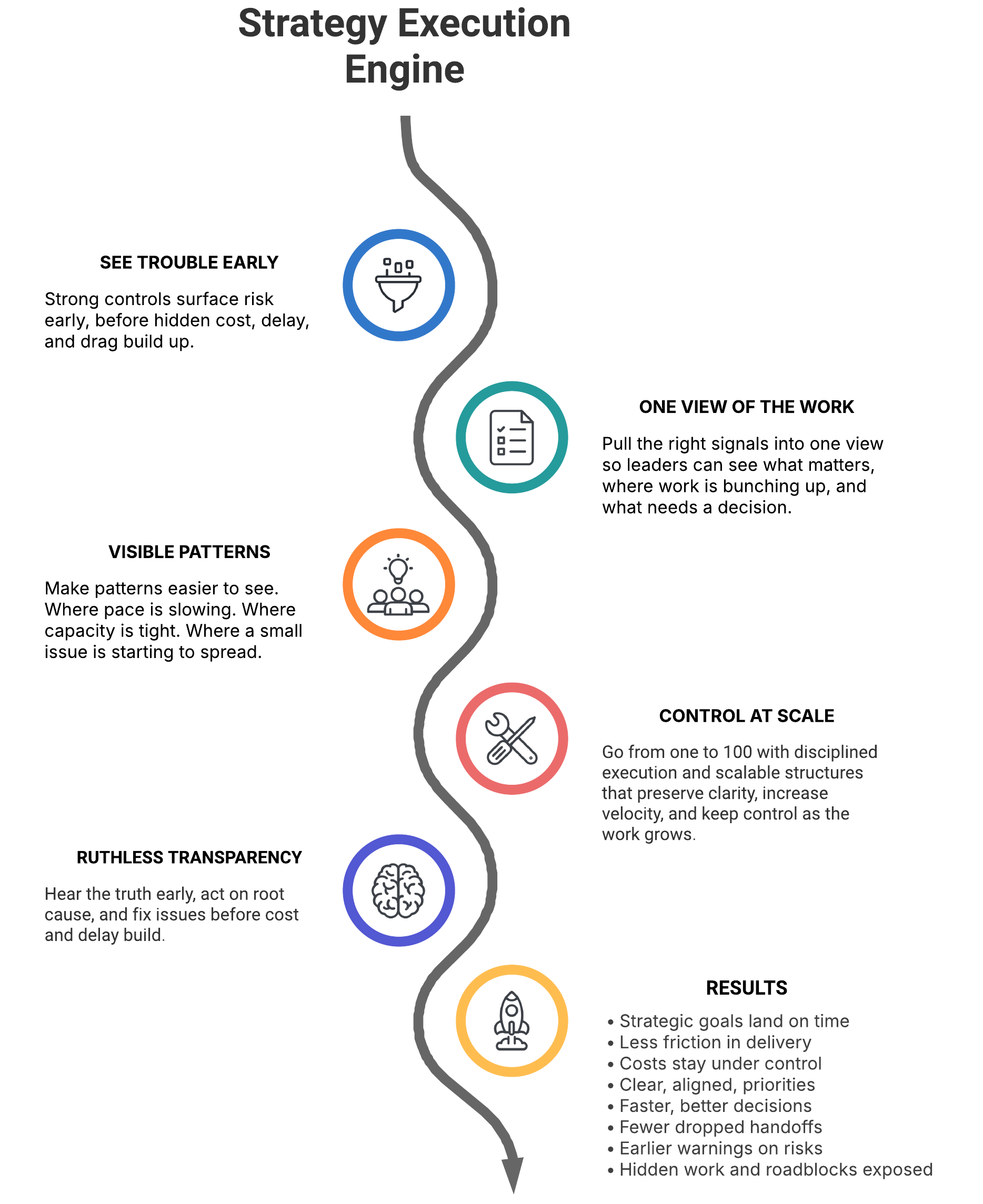
That is why the work behind strategy execution can be easy to underestimate. A fully managed PMO and disciplined project delivery reduce friction early, clear confusion quickly, and create the right amount of visibility to turn information into action without drowning people in detail.
Done well, disciplined delivery can look effortless.
The best teams catch lightning in a bottle and make it look as easy as children gathering fireflies into a jar on a warm summer evening.
That is the compliment and the risk.
When hard work looks easy, people start to believe it should be easy to repeat with the same outcome.
It rarely is.
That is why fully managed PMO services matter. They bring the structure, visibility, discipline, and leadership needed to make complex strategy execution look simple from the outside because the system underneath is designed to hold the work together.
What Executives Should Watch For
If you are leading a strategic initiative, pay attention to the work beneath the visible work.
Ask how risks are being found before they become problems.
Ask how decisions are being moved before they become delays.
Ask how dependencies are being tested before they become excuses.
Ask whether the dashboard is creating real visibility or simply reporting activity.
Ask whether your PMO is helping leadership make better decisions or just collecting updates.
Ask whether the team has a way to handle pressure when the plan meets reality.
These questions matter because complex initiatives do not need more noise. They need structure, judgment, and execution discipline.
They need someone watching the quiet moments.
The prep.
The follow-up.
The hard conversations.
The small corrections.
The details no one notices because they were handled before they became a problem.
That is where the real work happens.
That is why easy is hard to repeat.
And that is why the right delivery system can make the difference between a strategic initiative that looks good on paper and one that actually delivers.