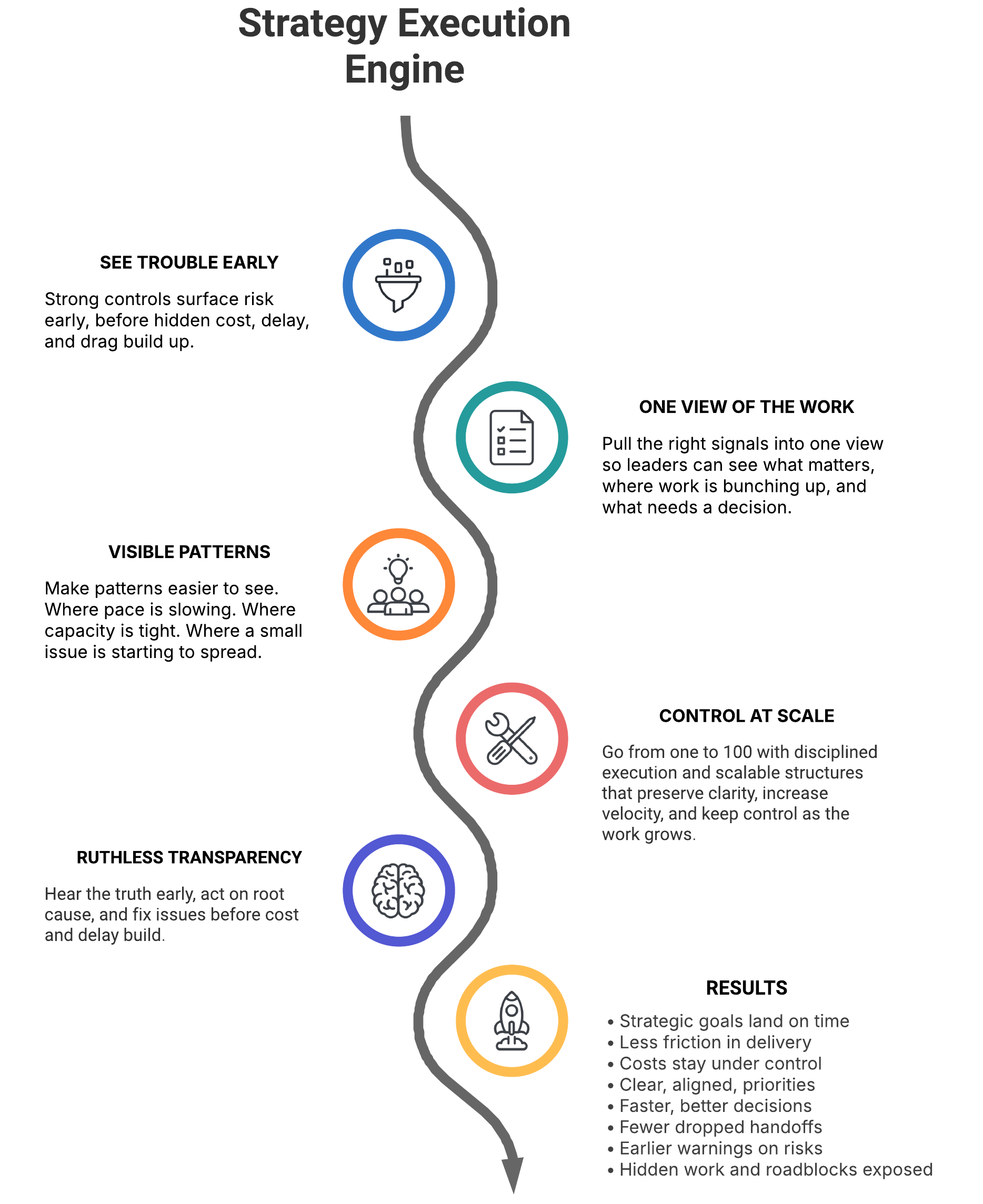

Many organizations believe they struggle with strategy execution when the real issue is a lack of portfolio prioritization discipline. Strategic plans are approved, funding is allocated, and initiatives are launched—but too many projects move forward at once, diluting focus and slowing delivery across the board.
The result is predictable: everything is labeled a priority, yet nothing moves quickly enough to produce meaningful impact.
The Cost of Undisciplined Prioritization
Research from the Project Management Institute consistently shows that organizations with low portfolio management maturity waste significantly more investment than those with structured prioritization and governance practices. In its Pulse of the Profession research, PMI found that poor project selection and prioritization contribute directly to billions in lost value annually.
This loss rarely shows up as a single failed initiative. Instead, it manifests as:
- delayed digital transformation programs
- overextended operational teams
- strategic initiatives that never reach full adoption
For executive leaders, this slow erosion of momentum is harder to detect than a visible project failure, yet it is often more damaging over time.
Why Everything Becomes a Priority
In credit unions and similarly regulated organizations, the pressure to maintain compliance, modernize systems, and improve member experience creates a constant influx of legitimate work. Without a disciplined prioritization framework, leadership teams tend to approve initiatives based on urgency, sponsorship, or perceived risk rather than enterprise value.
Harvard Business Review contributor Antonio Nieto-Rodriguez has written that many organizations run too many projects simultaneously, which reduces the probability of success across the portfolio and delays the realization of strategic benefits (The Project Economy Has Arrived, 2021).
This is not a failure of leadership intent—it is a structural gap in how work is admitted into the portfolio.
What Portfolio Prioritization Discipline Looks Like in Practice
Portfolio prioritization discipline does not mean fewer ideas or slower decision-making. It means establishing clear, repeatable mechanisms that determine:
- which initiatives enter the portfolio
- when they start
- and which work must pause when capacity is exceeded
High-performing PPMOs embed this discipline through three core controls:
1. A single, enterprise prioritization model
All initiatives are evaluated against the same criteria—strategic alignment, regulatory requirement, risk reduction, and expected value. This prevents local optimization and ensures transparency in decision-making.
2. Capacity-constrained planning
Approved initiatives are sequenced based on available delivery capacity, not just funding availability. This ensures that teams are not spread across too many concurrent efforts.
3. Governance that enforces trade-offs
Portfolio review forums are empowered to defer or cancel work when higher-value initiatives emerge. Without this authority, prioritization frameworks degrade into advisory tools rather than decision mechanisms.
The PPMO’s Role in Enforcing Strategic Focus
A common misconception is that prioritization is a one-time planning activity conducted during annual strategy sessions. In reality, it must be treated as a continuous control, with the PPMO acting as the steward of portfolio integrity.
Gartner has noted that organizations with mature portfolio governance processes are significantly more likely to deliver on strategic objectives because they actively rebalance investments as conditions change (Close the Strategy-to-Execution Gap With Strategic Portfolio Management, 2023).
For the PPMO, this shifts the function from reporting on project status to actively managing the flow of work into and through the organization.
Why This Matters More in Credit Unions
Credit unions operate with constrained budgets, smaller technology teams, and a strong obligation to maintain member trust. When prioritization breaks down, the impact is immediate: core system upgrades slip, digital initiatives stall, and regulatory work crowds out member-facing innovation.
Unlike larger financial institutions, credit unions often cannot absorb prolonged execution inefficiency. Portfolio prioritization discipline becomes not just a governance best practice, but a safeguard for institutional competitiveness.
Moving from Priority Lists to Portfolio Control
Many organizations maintain long lists of ranked initiatives but fail to connect those lists to real execution decisions. True prioritization discipline requires:
- stopping lower-value work when higher-value work emerges
- sequencing initiatives based on capacity and dependency, not calendar cycles
- revisiting priorities whenever business conditions shift
These behaviors are uncomfortable because they force visible trade-offs. However, they are also the behaviors that distinguish organizations that consistently deliver strategic outcomes from those that repeatedly defer them.
Conclusion
Strategic alignment is often discussed in terms of vision, roadmaps, and transformation themes. Yet the daily reality of execution is governed by which projects receive resources and which do not. Without portfolio prioritization discipline, even the most thoughtful strategy will fragment into competing initiatives that stall each other’s progress.
For executive leaders and PPMO practitioners, the path forward is clear: treat prioritization as an enforceable operating mechanism, not a planning exercise. When organizations build the structures to admit, sequence, and stop work based on enterprise value, strategy execution becomes faster, more predictable, and far more resilient to change.
Reference
Pulse of the Profession | Project Management Institute | 2025
Close the Strategy-to-Execution Gap With Strategic Portfolio Management | Gartner | 2023
The Project Economy Has Arrived | Antonio Nieto-Rodriguez | Harvard Business Review | 2021